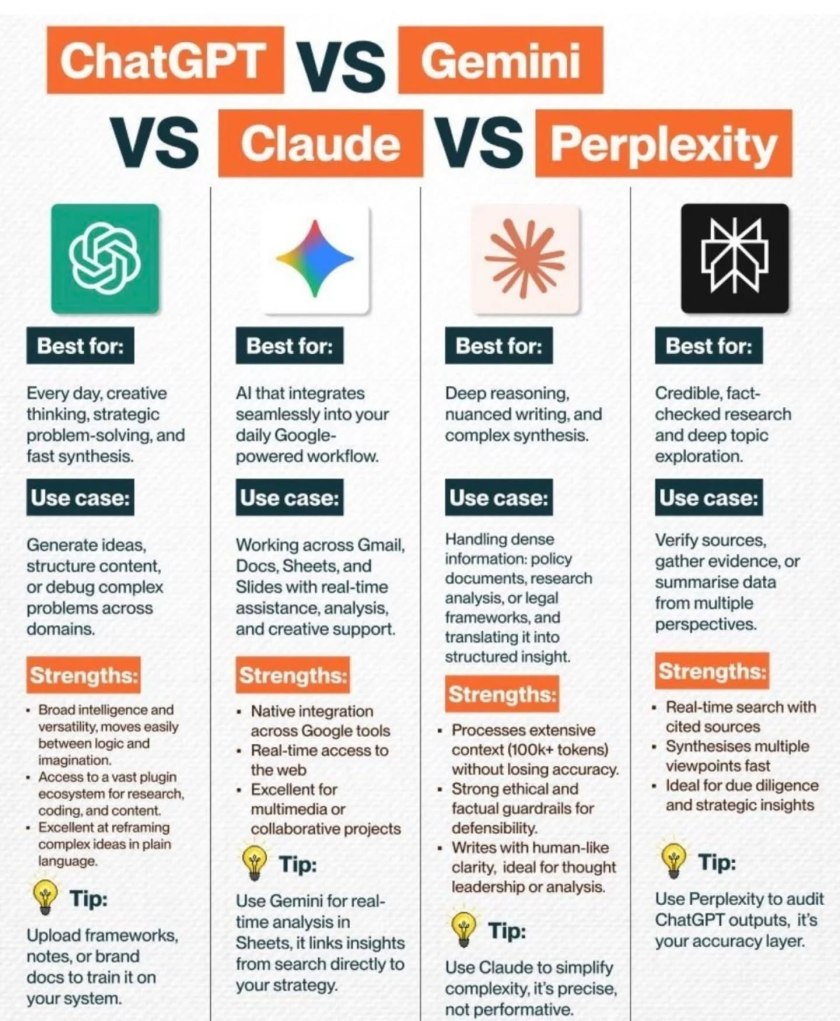
Put AI to Work (before your appetizer arrives)

Assuming you’re dining alone, or with an understanding and forgiving co-diner, you can eat some brain-food before the fried mozzarella sticks arrive, in a few seconds with these tips from Kim Komando.

Kim‘s a fun one to follow, for real-life tips.

Diane’s my personal guru. Who’s yours?

And just for laughs, some sites you might never have seen before that will help you use AI the bestest ways:

Traveling this summer?

Home is where your e-knowledge is. You have all you need, right? Everything about your e-setup is cozy and easy to use. You know your smartphone’s tricks like the back of the hand that’s always holding it, right?

And you seldom have to use an e-map at home. After all, when BFF says to meet by the Dolphin Fountain, you know exactly how to get there. But what happens when your travel buddy says “I’m just past the gelato stand” and you can’t find the stand or them? Here’s the secret map setting to use.

But then you get on your plane to Timbuktu* and you have to set your phone to airplane mode. Let’s face it: it’s a looong flight and your companion wants to listen to their podcasts or watch that classic movie they’ve always meant to watch… can they, in airplane mode? Yup. We’ve prepared a printable summary of what airplane mode can do for you to tuck into your carryon. It’s from the STUG Monitor, a members-only benefit. Want to subscribe?

* Why do we say Timbuktu when we mean strange, far-off place? I wondered too.

OneDrive Almost Ate My Files

A cautionary tale for anyone setting up a new Windows 11 machine — or upgrading from Windows 10

[Article written by Kate Holmes, STUG volunteer, with organizing help from Claude AI. I was too shook up to take proper notes of the fiasco.]

I recently got a new laptop and set merrily to, transferring my digital life from old to new. I’ve done this before. I know what I’m doing. Or so I thought. I finished the switchover in record time. Or so I thought.

Within the first few days, I noticed something odd. Files I was sure I’d saved to my Desktop weren’t where I expected them. Documents I’d created weren’t in my Documents folder — or rather, they were, but the folder wasn’t where it was supposed to be. Things felt slightly off in a way that was hard to pin down.

What had happened? OneDrive had quietly moved in and rearranged the furniture. Without asking.

What OneDrive Does (That Nobody Tells You)

When you set up a new Windows 11 machine, or often when Windows 10 upgrades to Windows 11, OneDrive doesn’t just offer to back up your files. It goes ahead and redirects your core folders — Desktop, Documents, and Pictures — into its own sync folder, deep inside your user directory. Your Desktop is no longer at C:\Users\YourName\Desktop. It’s now at C:\Users\YourName\OneDrive\Desktop.

The folders look exactly the same on screen. The Desktop still looks like a desktop. Documents still looks like Documents. Nothing waves a flag to tell you that these locations have been silently relocated into Microsoft’s cloud sync system.

This matters for several reasons:
* Files you think are local may actually be in the cloud even only in the cloud, if OneDrive decides to free up local space
* If your internet connection drops, OneDrive can lose the plot. Files can appear to vanish or become inaccessible
* Anything that syncs to the cloud is subject to Microsoft’s terms, not just sitting quietly on your hard drive
* If you later unlink OneDrive, those redirected folders can end up stranded in unexpected locations

And here’s what happened to me: I accidentally sent a very large folder to the Recycle Bin during cleanup. Because it was inside OneDrive, recovering it was a hair-tugging exercise. It worked out, but only because I caught it fast (and I had AI on my side.)

This Isn’t Just a New Laptop Problem

If you are upgrading an existing machine from Windows 10 to Windows 11, you may hit the same issue. The Windows 11 setup process prompts you to sign in with a Microsoft account and strongly nudges you toward OneDrive backup. Many people click through those screens without realizing what they’re agreeing to. The folder redirect can happen during that process just as easily as it did on my brand-new machine.

If you’re already on Windows 11 and you’re not sure whether this has happened to you, here’s the quick check: open File Explorer, right-click on your Documents folder, choose Properties, and look at the Location tab. If the path shown contains the word “OneDrive,” your folder has been redirected.

What To Do About It

On a new machine, before you do anything else: when Windows setup asks about OneDrive backup, decline it, or at minimum, uncheck the folder redirection options. You can always set up OneDrive manually later, on your own terms.
If the redirect has already happened: you can move the folders back. Right-click the folder → Properties → Location → Restore Default. Windows will move everything back to the local path. Do this before you unlink OneDrive, or things get complicated. [Note from Kate: Claude AI says this. I didn’t try that, so you’re on your own; remember, AI ain’t always right.]

Learn from my mess: unlink OneDrive before doing anything else on a new Windows machine.

Get your files settled, your folder structure sorted, and your backup solution chosen deliberately. You might choose OneDrive, Dropbox, Google Drive, or something else. Only after you’re happy with your structure should you set up cloud sync on your own terms.

Now I assume that OneDrive is not a bad product. For people who want seamless cloud backup and don’t mind their files living in Microsoft’s ecosystem, it works well. But the way Windows 11 deploys it, silently, during setup, without a clear explanation of what folder redirection actually means, is a genuine gotcha. It catches experienced users, not just beginners.

Consider yourself warned.

Speaking of cloud storage options — I asked Claude to put together a comparison chart of the major services, including OneDrive, Google Drive, Dropbox, iCloud, pCloud, and MEGA, showing free tiers, pricing, and sync capabilities. [View or print the chart here.]

Photo credits Designboom.com, Sunday Robotics

How to Zoom Like a Pro

This article comes to STUG through STUG’s membership in APCUG, the International Association of Technology and Computer User Groups.

First, check that you have the latest Zoom version at www.zoom.us/download. Join a meeting by clicking on the unique link your group has sent you.

Settling in

Check your audio and video

Move your mouse to the bottom left of your monitor/screen to activate the Zoom Toolbar. You will see the icon for the audio (mic) and video (camera). Click the caret (^) beside either icon and make sure the correct devices are selected. You can also select “Test speaker & microphone” in Windows or go to audio settings in Linux.

Need to change your name? “BooBoo” might be perfect for your family Zoom, but if you’d rather not share that nickname with the world, You can adjust what participants in the current meeting see. Move your mouse to the top-right corner of your tile, then click the three dots or right-click on the box. From the menu, select “Rename,” enter your correct name, and then click “Change.” Now, you are ready to sit back and enjoy the Workshop. You can also click on the “Participants” icon, find your name, click the three dots, and select “Rename.”

During the Meeting

Hear. How well you “hear” what’s being said is under your control. You adjust the volume either in Zoom’s audio settings (caret (^) next to the mic) or in your device’s volume settings. It has been noticed that, at times, the volume on your device may not be accurately reflected in Zoom. Therefore, you will need to adjust Zoom’s audio settings.

See. What you “see” during the Workshop is also under your control. Your first adjustment is how you see the main screen. In the top right corner, you will have a “tic-tac-toe” button. You have a number of choices, including: “Speaker” (where you see the person speaking in a big window and other attendees in a filmstrip) and “Gallery” (where you see attendees in rows—Hollywood Squares). We recommend the Speaker view, as you are here to see the presenter. The “Gallery” view may have additional screens, depending on the number of attendees and the number of tiles your device can display simultaneously. You can also view the meeting in “Fullscreen” mode.

View. When the presenters are sharing their screens, you have a second set of “viewing” controls. Move your mouse to the top-left center of your screen, where you should see a tab labeled “Presenter’s screen” with a circle and three dots. There, you can select the “Zoom ratio” and make it easier to see if your screen is too small. You can also remove the attendee’s filmstrip by checking “Hide video panel.”

Open Mic. If there is an “Open Mic Q&A” and you want to ask a question or share a comment, click the raised-hand icon on the Zoom taskbar. If you don’t see it, check under “More” or under the “React” icon. This puts you at the top of the attendees list and lets the leader know you want to speak. When it’s your turn, you will see “Please unmute your mic.” Please click your “Audio icon” (the mic) and unmute yourself, and then you can speak.

APCUG hopes that these instructions and reminders will help make your participation in any workshop or presentation a pleasant experience.

Thanks to John Kennedy of APCUG

Such good folks!

After retiring, many of our fellow citizens here in the Sarasota/Manatee area volunteer, putting their past experience to work for the good of others. Such are the crew of our Refurb Group here at Sarasota Tech Users Group.

Their good work is often noted by the media, such as today’s article in The Observer.

We send our thanks, along with thanks from the recipients of those  25,415 refurbished devices, to Anda S, Bill Crowe, Bruce C, Chuck W, Doug Weiss, Garth H, Kathy K, Randy T, Sandy M, Mike Hutchinson and most especially, Saul Lowitt!

And you can thank them too by participating in April’s Giving Challenge, which comes along only once every two years and is a major source of funds for batteries, parts, and more at the Refurb Group.

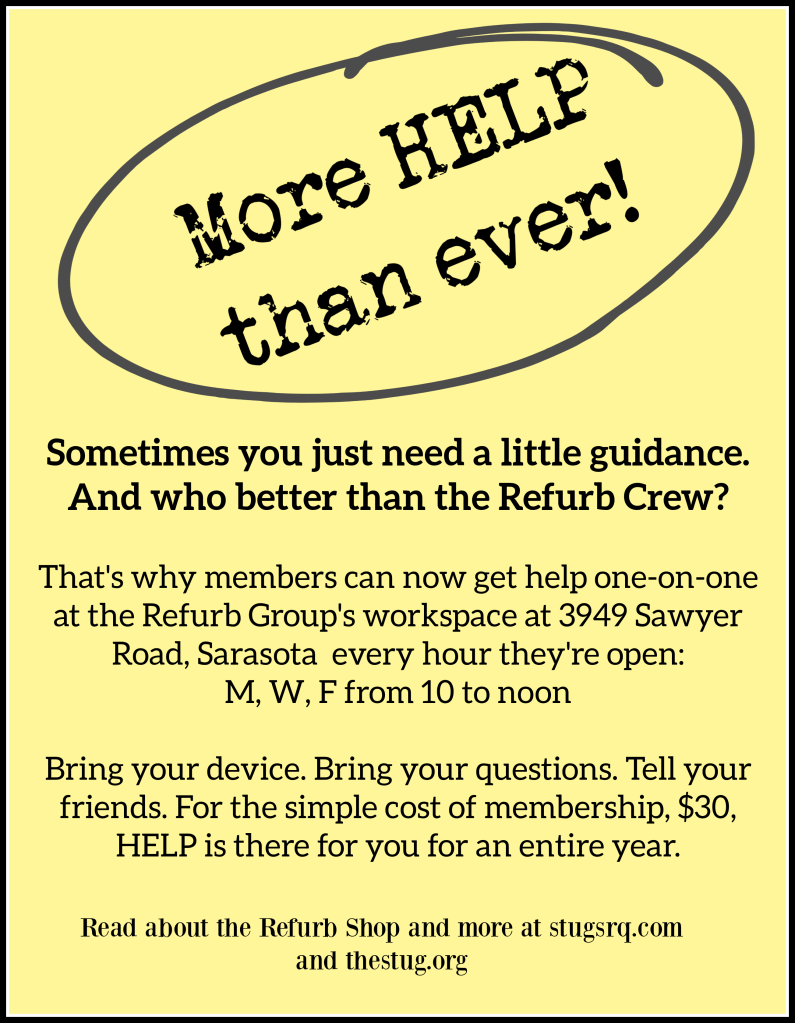
PS Did you hear? The HELP DESK is now open even longer hours!

A new event! Remember field trips?

Well, STUG is offering one for its members on Saturday February 28 at 2PM. It’s a trip to the future… read on. Hope to see you there. Keep reading…

Didn’t you love field trips when you were just a little tyke? Here’s our newest educational offering, and I dunno about YOU but I want to see all the cool stuff that will be just normal everyday stuff in the future. Join us!

Step into the Future
Saturday Feb 28 at 2PM
Suncoast Science Center/Faulhaber Fab Lab

Our youngest Board Director, Prabhav Govindu, will be there to explain it all! Members only, free but donations to Fab Lab accepted. Meet 5 or 10 minutes before in the parking lot at 4452 S Beneva Road (bet. Bee Ridge & Proctor Roads). The entrance to Fab Lab is at the BACK of the building

25,000 and more!

What a way to celebrate the end of 2025 and look forward to 2026! The head of our Refurbishing Project, Mike Hutchinson, sent a modest little email to the Sarasota Tech Users Group board saying

“The Refurb Project passed  25,000 computers refurbished last week.”

Now, I think that’s worth some fireworks, don’t you? The STUG Refurb Project began renovating computers in February 2004. Now, in 2026, over 25,000 computers have been donated to our community. Recipients include disadvantaged school children, low-income adults/seniors, individuals in recovery programs and others trying to emerge from homelessness or other problems. In 2013 the program was expanded to provide computers directly to students in the Sarasota County school system.

The Refurb Project works with directly with many local non-profits. Counselors from these organizations identify those in need and coordinate getting the computers to the individuals. The Children’s Guardian Fund is one that the Refurbishing Project works very closely with to get the computers into the hands of area foster youth.

To give you an idea of just how much 25,000 computers are: They would weigh more than a herd of full-grown elephants!

 Credit Corey Favino / Elephant Family USA and Newport Restoration Foundation

But more important than what they weigh, these 25,000 refurbished machines mean:

25,000 second chances at digital access
25,000 fewer computers in landfills
25,000 doors opened to education, jobs, and connection

More computing power than existed in the entire world in the 1970s, refurbished by a small group of volunteers and supported by donations of devices and operating funds by our community.

Read more about Refurb and how you can help.